

Board Performance · 2025
In this section12 topics
- Prevention of Conflicts of Interest3 items
- Prevention of the Use of Inside Information4 items
- Anti-Corruption4 items
- Whistleblowing3 items
- Selection of Directors & Chief Executives5 items
- Selection of Independent Directors2 items
- Evaluation of Board & Subcommittee Performance3 items
- Subcommittees1 item
- Meeting Attendance & Remuneration4 items
- Supervision of Subsidiaries & Associated Companies4 items
- Audit Committee Duty Performance1 item
- Executive Committee Duty Performance1 item
Prevention of Conflicts of Interest
Has the Company Acted to Prevent Conflicts of Interest?
Yes
Operations in the Past Year
Board of Directors has established measures to oversee transactions and review improper related party transactions in the Business Ethics Handbook, concerning interests and conflicts of interest. which is part of the orientation training program for new directors, executives, and employees, and is also published on the company's website, with the content summarized as follows:
Avoid engaging in transactions involving oneself or related individuals/entities that may create a conflict of interest with the company, unless the interest has been disclosed and specific authorization or in-principle approval has been obtained.
Not engaging in business that competes with the company, whether directly or indirectly. In cases where directors, executives, and employees are involved in any business, that work must be of the following nature:
Not contrary to the company's interests or not a business that competes with the businesses of the group of companies.
No adverse effect on the company's reputation or operations.
Not affecting their duties and responsibilities.
The Board of Directors and executives must carefully consider conflicts of interest regarding related party transactions of the company and its subsidiaries, with honesty, integrity, reason, and independence, and with commercial terms that a reasonable person would enter into with general business partners of the company or its subsidiaries.
Interested parties must not participate in the consideration of transactions where they have a conflict of interest.
Directors, executives, and employees must report and disclose any transactions suspected of involving themselves or their related parties having a conflict of interest with the company, by informing their supervisor and submitting it to the Board's office.
Every quarter, the Internal Audit Department will collect information on related party transactions and present it to the Audit Committee meeting for consideration of reasonableness and transaction conditions, demonstrating transparency and absence of conflicts of interest, to report to the Board of Directors for acknowledgment, monitoring, and oversight within the framework of good corporate governance.
Number of Conflict-of-Interest Cases
| Metric | Current Year | Previous Year | Two Years Ago |
|---|---|---|---|
| Total number of cases or issues related to conflicts of interest (cases) | 0 | 0 | 0 |
Prevention of the Use of Inside Information
Introduction
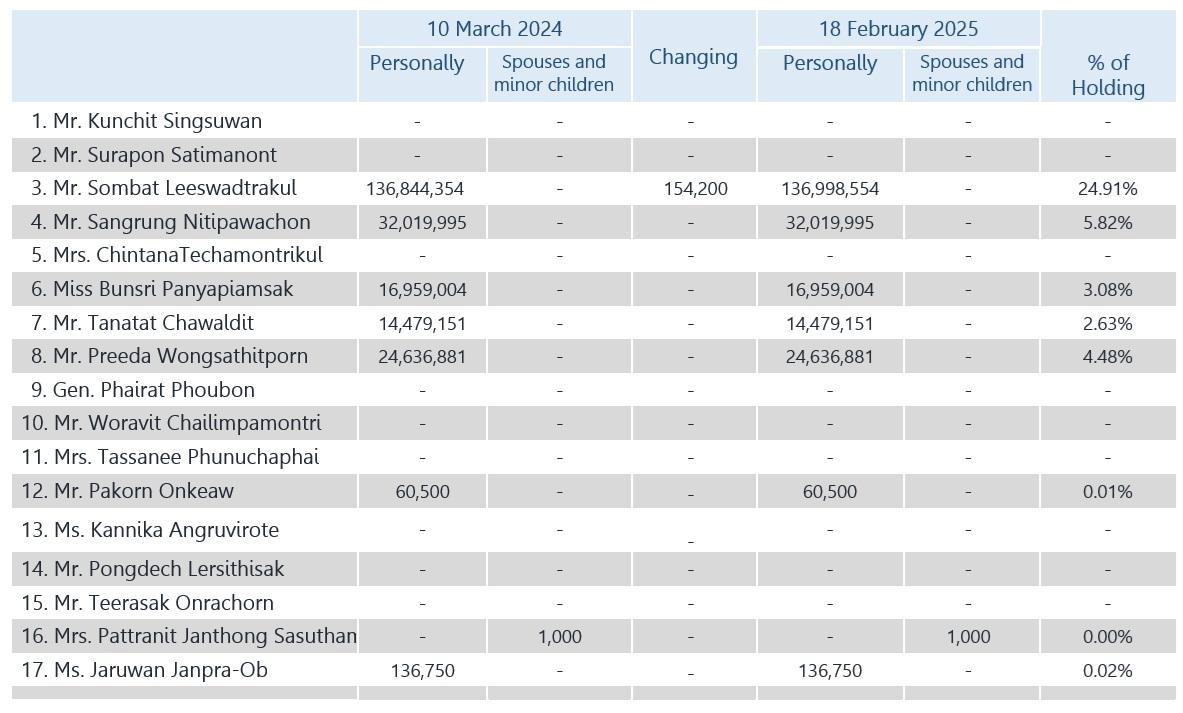
The company has established measures to prevent the misuse of inside information in two parts: a) personal data of customers, employees, and business partners; and b) the use of undisclosed performance information to seek benefits in the trading of the company's securities ( Insider Trading). In 2025, there were no reported disputes regarding the use of inside information for personal gain by directors, executives, and employees involved with inside information. including spouses and minor children of such individuals.
Changes securities holdings of directors and executives have as follows
Has the Company Acted to Prevent the Use of Inside Information?
Yes
Operations in the Past Year
In 2025, the Company organized training for employees of the Group to review the content and test their knowledge of business ethics and practices through the system. intranet to be aware of the correct use of inside information and the offense of using inside information for undue personal gain.
Number of Inside-Information Cases
| Metric | Current Year | Previous Year | Two Years Ago |
|---|---|---|---|
| Total number of cases or issues related to the use of inside information to seek benefits (cases) | 0 | 0 | 0 |
Anti-Corruption
Has the Company Acted on Anti-Corruption?
Yes
Operations in the Past Year
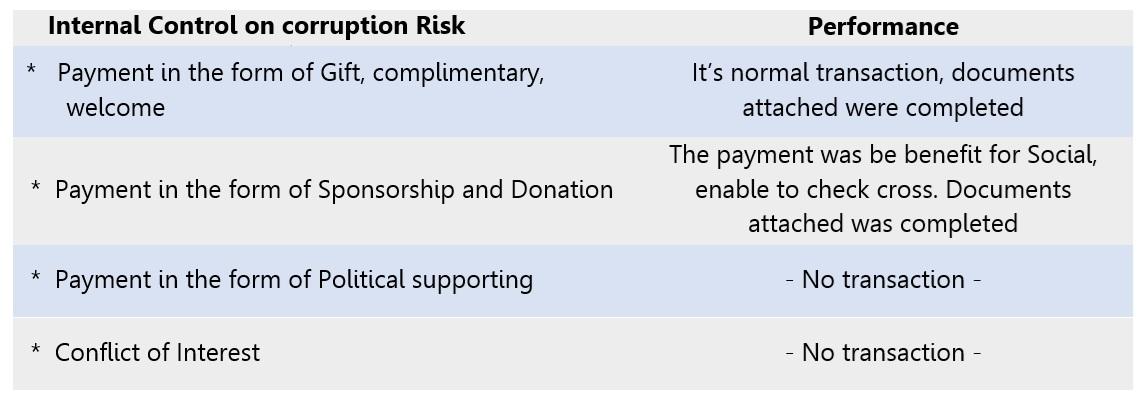
Each year, the Audit Committee establishes an internal audit plan for various transactions that carry a risk of corruption with government agencies and regularly reports the results to the Board of Directors. In 2025, the Company's anti-corruption operations are as follows:
Training for Human Resources Development staff, launching a self-learning training system for existing employees to review practical guidelines once a year, and conducting orientation training for new employees to inform them of the company's key policies, including the anti-corruption policy.
The Internal Audit Department assessed the adequacy of the process for contacting government agencies, with responsible personnel adhering to the procedures, regulations, and criteria of those government agencies. A random audit of transactions related to government agencies within the group of companies from January to December 2025, totaling more than 330 items, is as follows:
3. The company's certification as a member of the Private Sector Collective Action Against Corruption (CAC) was renewed for the second time.
Form of Anti-Corruption Operations
| Operation |
|---|
| Assessment and identification of corruption risk |
| Communication and training for employees on anti-corruption policy and guidelines |
| The monitoring of the evaluation of compliance with the anti- corruption policy |
| Review of the completeness and adequacy of the process by the Audit Committee or auditor |
Number of Corruption Cases
| Metric | Current Year | Previous Year | Two Years Ago |
|---|---|---|---|
| Total number of cases or issues related to corruption (cases) | 0 | 0 | 0 |
Whistleblowing
Has the Company Implemented Whistleblowing Procedures?
Yes
Operations in the Past Year
Complaint/Whistleblowing Channels All stakeholder groups can report complaints regarding misconduct, rights violations, or breaches of ethical principles in good faith through the following channels:
Mail : Audit Committee
2S Metal Public Company Limited
No. 1788, Singha Complex Building, 30th Floor (Regus),
New Petchburi Road Bang Kapi Sub-district
Huai Khwang District Bangkok 10310
Email : auditcom@2smetal.com
Number of Whistleblowing Cases
| Metric | Current Year | Previous Year | Two Years Ago |
|---|---|---|---|
| Total number of cases or issues received through whistleblowing channels (cases) | 0 | 0 | 0 |
Selection of Directors & Chief Executives
Are Directors Selected Through the Nomination Committee?
Yes
Are Chief Executives Selected Through the Nomination Committee?
No
Number of Directors from Major Shareholders
5
Rights of Minority Shareholders on Director Appointment
The Company promotes good corporate governance and assures shareholders that their rights are treated equally. The Company has granted shareholders the right to propose meeting agendas and nominate individuals for election as directors at the Annual General Meeting of Shareholders for the year 2026, in advance, effective immediately. Details of the criteria and procedures set by the Company are disclosed on the Company's website at https://www.ss.co.th/general_meeting_thv2/
Method of Director Appointment
| Method |
|---|
| Method whereby each director requires approval votes more than half of the votes of attending shareholders with voting rights |
Selection of Independent Directors
Criteria for Selecting Independent Directors
Independent Directors: The Company has established qualifications for independent directors in accordance with the minimum requirements of the SEC Office and the Stock Exchange of Thailand, namely:
Holds no more than 1% of the total issued and paid-up registered capital of the company and its related companies, including shares held by related persons.
Is not a person with a relationship with the company and its related companies in a manner that involves a conflict of interest or financial or management benefits, both currently and during the period of 2 years prior to being an independent director, with the following relationship characteristics:
* is a director involved in management, an employee, or a staff member. consultant receiving a regular salary or
a controlling person.
* is a professional service provider. such as an auditor, legal advisor, financial advisor, or asset appraiser.
* is a person with a business relationship, such as buying/selling goods or services. buying/selling assets,
providing/receiving financial assistance, etc.
Is not a person with a blood relationship or a legally registered relationship, such as a parent, spouse, sibling, or child of an executive. major shareholder, controlling person, or a person to be nominated as an executive or controlling person of the company.
Has no business relationship with the company or any legal entity that may have a conflict of interest in a manner that could impede independent judgment, and has no other characteristics that would prevent them from providing independent opinions regarding the company's operations.
Is not an audit committee member in another company with the same business nature and which is in business competition with the company.
The term of office for independent directors shall be in accordance with the term of office for company directors. 9 years since appointment. independent directors can still provide independent opinions in accordance with relevant criteria, and their proportion is half of the total number of directors, thus providing a balance in considering various matters.
Audit committe consists of at least independent directors. 3 persons. Furthermore, at least one audit committee member must be a person with sufficient knowledge and experience in accounting or finance to be able to review the reliability of financial statements. The company will also consider other qualifications, such as business experience, specialized expertise related to the business, ethics, etc.
Did Any Independent Director Have a Business or Professional Relationship?
No
Evaluation of Board & Subcommittee Performance
Criteria for Evaluating Board Performance
the Board of Directors evaluated performance during the year with self-assessment form at least once a year, a evaluation summary of each committe were reported to the Board of Directors. Structure of self-assessment consist;
a) Structure and qualifications of each committee
b) Roles, duties, and responsibilities of directors
c) Meetings and reporting of each committee
d) Other matters such as the performance and development of directors, and the relationship between
directors and management
Evaluation results are divided into 4 levels
1 Disagree, or the matter has been minimally implemented
2 Agree, or the matter has been reasonably implemented
3 Moderately agree, or the matter has been well implemented
4 Strongly agree, or the matter has been excellently implemented
Evaluation of Board Performance in the Past Year
In the year 2568 The Board approved the use of the director performance evaluation form from the Thai Institute of Directors Association, with a total of evaluations. 4 The following groups:
Full Board self-assessment form, with an average of 9 5.42 with the opinion that director development is still insufficient.
Sub-committee self-assessment form
- Audit Committee, with an average of 100.00 with the opinion that information regarding the internal control
system, meetings, and reports is sufficiently appropriate.
- Nomination and Remuneration Committee, with an average of 89.26 with the opinion that meeting information
is still insufficient.
- Risk Management Committee, with an average of 94.14 with the opinion that meeting information and reports
are still insufficient.
3. Individual director self-assessment form, average 93.80 Independent directors opined that they have independence
in making recommendations. For the remaining directors, readiness to perform duties should be increased.
4. Performance evaluation of senior executives d Avg average is at 97.22
Evaluation Results
| Evaluated Body | Group — Carried Out? | Group — Grade / Average Score | Group — Grade / Full Score | Individual (Self-Assessment) — Carried Out? | Individual (Self-Assessment) — Grade / Average Score | Individual (Self-Assessment) — Grade / Full Score | Cross (Assessing Other Directors) — Carried Out? |
|---|---|---|---|---|---|---|---|
| Board Of Director | Y | 95.42 | 100.00 | Y | 93.80 | 100 | N |
| Audit Committee | Y | 100 | 100 | N | N | ||
| Other Subcommittee | Y | 89.26 | 100.00 | N | N | ||
| Other Subcommittee | Y | 94.14 | 100 | N | N |
Subcommittees
Subcommittees
| Results of the Subcommittee's Duty Performance |
|---|
The Nomination and Remuneration Committee (NRC) comprises 4 members: three independent directors and one executive director. These individuals possess knowledge and experience beneficial to their duties, supporting the corporate governance of the Board of Directors. In 2025, a total of two meetings were held (all directors attended every meeting) to jointly consider the following: 1. For the selection of qualified individuals to serve as company directors, the NRC considers skills, experience, and knowledge according to the Board Skill Matrix, aligning with the company's business operations. To ensure suitable individuals for enhanced corporate governance, the company invited minority shareholders to participate in nominating individuals for directorships, by disseminating news through the Stock Exchange of Thailand's system and on the company's website from December 15, 2024, to January 31, 2025. It was found that no shareholders nominated any individuals for consideration as company directors at the Annual General Meeting of Shareholders for 2025. However, in 2025, three directors are due to retire by rotation. Of these, one is an independent director. Although this director has served for more than nine consecutive years, they continue to perform their duties and provide independent opinions, free from management influence. Furthermore, they possess legal and internal audit expertise, consistently offering beneficial suggestions or advice to the company. Upon reviewing the qualifications, responsibilities, and performance over the past year, the directors due to retire by rotation are fully qualified and do not possess any prohibited characteristics under relevant laws/notifications. Therefore, it is proposed that the Board of Directors consider approving the re-election of all three directors for another term, before submitting the proposal for approval at the Shareholders' Meeting. 2. The NRC considered and determined the remuneration for non-executive directors by comparing it with remuneration data from similar industries, alongside economic conditions and the company's operating results, to propose to the Board of Directors for approval, before submitting it for approval at the Shareholders' Meeting. Details of the directors' remuneration are presented in Section 8.1, "Summary of the Board of Directors' Performance". 3. The Nomination and Remuneration Committee (NRC) assigned the Company Secretary to compile the performance evaluation summary of the company's directors for the past year to report to the Board of Directors. The objective is for directors to review their performance and issues related to their duties in accordance with corporate governance principles. Each director conducted a self-assessment (Self-Assessment) for the entire board, individually, and for sub-committees. Furthermore, the NRC was assigned by the Board of Directors to jointly evaluate the performance of the Chief Executive Officer, to report to the Board of Directors' meeting. Details of the performance evaluation results for each committee are presented in Section 8.1, "Summary of the Board of Directors' Performance over the Past Year". In summary, the Nomination and Remuneration Committee has diligently performed its duties as assigned by the Board of Directors, fully within the defined scope of authority and responsibilities. This report was reviewed and approved by the Nomination and Remuneration Committee on February 25, 2026. Gen. Pairat Pho-ubon Chairman of the Nomination and Remuneration Committee |
The Board of Directors recognizes the importance of enterprise risk management to ensure that organizational risks are managed adequately, appropriately, promptly, and in alignment with business strategies. Therefore, a Risk Management Committee comprising 4 members has been appointed to define strategies, policies, and guidelines for overall organizational risk management, as well as to manage risks to an acceptable level (Risk Appetite), thereby building confidence in achieving business objectives and fostering sustainable growth. In 2025, the Risk Management Committee held a total of 2 meetings to monitor and evaluate the effectiveness of risk management in alignment with the organization's objectives. The key points are summarized as follows: 1. Acknowledged and provided recommendations on the annual risk assessment results. The Committee considered and acknowledged the risk assessment reports at both the organizational and departmental levels to ensure coverage of significant risk factors for the steel industry. Furthermore, recommendations were provided to the management for integrating risk management into actual operational processes, thereby ensuring agile and coordinated responses to risks across the organization. 2. Reviewed and evaluated the results of enterprise-level risk management for the 6-month and 12-month periods. The Committee monitored the results of risk management according to the defined plan to assess whether the residual risk level was within the company's acceptable criteria, focusing closely on important issues that might affect operational performance. In 2025, the Risk Management Committee was of the opinion that the company has sufficiently effective and appropriate risk management for the business environment. The company is able to identify and manage significant risk factors to an acceptable level (Risk Appetite). The continuous monitoring of the risk management process every 6 months helps the company adapt to challenging situations promptly. |
Meeting Attendance & Remuneration
Justification for Directors' Non-Attendance
The director has a prior engagement and has notified the chairman of the meeting in advance.
Types of Remuneration of the Board of Directors
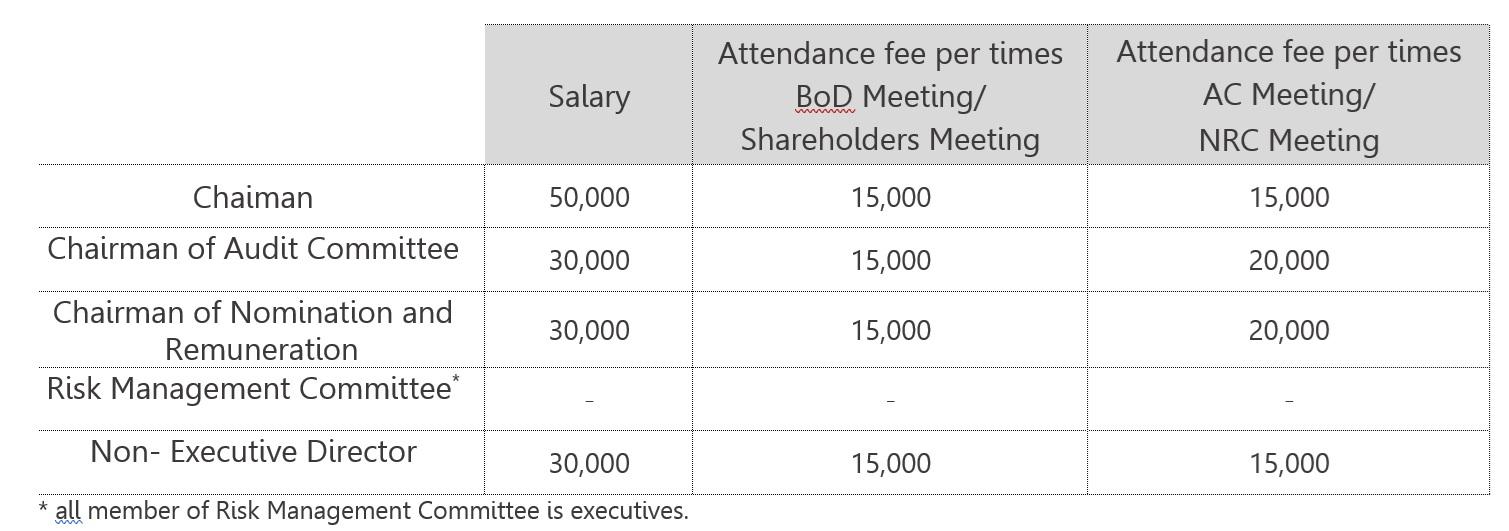
The Nomination and Remuneration Committee has considered the database from remuneration surveys of directors and executives of listed companies on the Stock Exchange of Thailand. This data was analyzed in conjunction with the company's performance before being presented to the Annual General Meeting of Shareholders for approval of remuneration in the form of salaries and per-meeting allowances for directors who are not the Company's executives, with a total budget for all committees not exceeding 4.00, which is the same rate as the previous year.
Remuneration of the Board of Directors
Remuneration or Benefits Payable to the Board
| Metric | Amount (Baht) |
|---|---|
| Remunerations or benefits pending payment to the board of directors over the past year (baht) | 0 |
Supervision of Subsidiaries & Associated Companies
Does the Company Have Subsidiaries or Associated Companies?
Yes
Is There a Mechanism for Overseeing Subsidiaries and Associated Companies?
Yes
Mechanism for Overseeing Management of Subsidiaries
To ensure that the management of subsidiaries aligns with the Company's strategies and policies, the Board of Directors has appointed directors/executives of the Company as authorized persons to control, supervise, and be responsible for the operations of the subsidiaries. It is stipulated that significant transactions, such as connected transactions and the acquisition or disposal of assets, must adhere to the same criteria as those prescribed by the Company.
Additionally, the Board of Directors requires subsidiaries to use the same auditor as the Company, so that data collection and accounting records of the subsidiaries are based on the same auditing standards and consolidated financial statements can be prepared within the stipulated timeframe.
Oversight Mechanisms
| Mechanism |
|---|
| Sending representatives to act as directors, executives or controlling persons in proportion to shareholdings |
| Defining the scope of powers, duties and responsibilities of directors and executives who represent the company in setting important policies |
| Disclosure of financial information and operating results |
| Transactions between the Company and related persons |
| Other important transactions |
| Acquisition or disposal of assets |
| Internal control system of the subsidiary operating the core business is appropriate and sufficient in the subsidiary operating the core business |
Audit Committee Duty Performance
Results of the Audit Committee's Duty Performance in the Past Year
The Board of Directors appointed an Audit Committee ("AC") comprising 3 independent directors, all of whom are highly qualified. One of these three directors possesses expertise in accounting and finance. AC performed its duties within the scope, authority, and responsibilities outlined in its charter and as assigned by the Board of Directors, in accordance with the regulations of the Securities and Exchange Commission (SEC) and the Stock Exchange of Thailand (SET), to support transparency and effectiveness in good corporate governance.
In 2025, AC held a total of 4 meetings, with all AC members attending every meeting, representing 100% attendance, together with relevant senior executives and internal auditors, as well as certified public accountants on relevant agendas. The key aspects of its operations are summarized as follows:
1. Review quarterly financial reports and financial statements for the year 2025. to comply with generally accepted accounting standards. This involved meetings with the certified public accountant, the Deputy Managing Director of Accounting and Warehouse, and other relevant senior executives to ensure that the financial statements accurately, completely, and reliably reflect the company's financial position and operating results. Furthermore, AC met with the certified public accountant without management present at the 4th/2025 AC meeting on November 13, 2025, to consider independence and any other concerns, if any.
2. Review the internal control system to assess the adequacy, suitability, and effectiveness of operational processes within the company and its subsidiaries. AC prioritized auditing all critical systems based on a risk-based approach that could impact the achievement of business objectives. Specifically, the oversight led to stringent practical measures, resulting in the company's second consecutive renewal of certification as a member of the Thai Private Sector Collective Action Against Corruption (CAC) in 2025. Based on the audit reports and quarterly follow-ups on corrective actions, in accordance with the approved annual audit plan, the Audit Committee is of the opinion that the company's internal control system is adequate and appropriate for the current circumstances. Continuous monitoring and improvement of issues identified during audits are in place to foster sustainable and transparent growth.
3. Review compliance with securities and stock exchange laws. Stock Exchange regulations, as well as other laws related to the business of the company and its subsidiaries, to build confidence among shareholders and investors.
4. Consider selecting and proposing the appointment of the auditor for the year 2025. considering their expertise, independence, and experience in auditing the steel products business, as well as the reasonableness of their service fees. This recommendation was then presented to the Board of Directors for approval by the Annual General Meeting of Shareholders. The Annual General Meeting of Shareholders resolved to approve the appointment of BDO Audit Co., Ltd. as the auditor for the company and its subsidiaries for the year 2025, due to its international operating standards and lack of relationships or interests with the company that could affect its independence in performing its duties.
5. Review related party transactions and the disclosure of information between the company and its related persons. to ensure that operations strictly comply with business conditions and criteria set by the Stock Exchange of Thailand. The internal audit unit was assigned to review the company's related party transactions and report to the Audit Committee quarterly. The review confirmed that commercial related party transactions were normal business transactions with general trading conditions, were reasonable, fair, and did not involve any transfer of benefits or create conflicts of interest.
Executive Committee Duty Performance
Results of the Executive Committee's Duty Performance in the Past Year
In 2025, the Executive Committee held 6 meetings to consider, acknowledge, and monitor the company's normal business operations and administrative work according to the situation at each period, in accordance with the roles and responsibilities assigned by the Board of Directors.