

Internal Control · 2025
In this section9 topics
- Internal Control — Board Opinion1 item
- Adequacy & Appropriateness of the Internal Control System1 item
- Internal Control Deficiencies1 item
- Audit Committee & Auditor Observations2 items
- Opinion on the Head of Internal Audit2 items
- Appointment, Discharge & Transfer of the Head of Internal Audit1 item
- Related Party Transactions1 item
- Counterparties & Transactions3 items
- Policy & Future Trends2 items
Internal Control — Board Opinion
Summary of the Board's Opinion on Internal Control
The Company recognizes the importance of a sound internal control system and has therefore established an internal audit unit. This unit is responsible for independently evaluating and improving the effectiveness of internal control processes, risk management, and corporate governance, in accordance with established policies, regulations, and criteria. It also assesses the adequacy of the internal control system and reports its findings to the Audit Committee for review prior to submission to the Board of Directors.
Adequacy & Appropriateness of the Internal Control System
Internal Control Framework Used
| Framework | Detail |
|---|---|
| The Committee of Sponsoring Organizations of the Treadway Commission (COSO) | At the Board of Directors meeting on November 13, 2025 to considered the results of the assessment of the adequacy of the internal control system, based on the assessment form of the Securities and Exchange Commission, which covers all five components of the COSO framework. In summary, 1. Organizational Internal Control The company has a clear organizational structure and defined scopes of authority for its directors and management, with written approval matrices for operational approvals. Management meetings are held to jointly set company goals. The company sets annual operational targets and reviews actual performance to determine targets for the following year. Furthermore, the company focuses on fostering business ethics and integrity in its operations by establishing a business ethics handbook and disciplinary penalties to guide executives and employees in their conduct. 2. Risk Management The company has appointed a Risk Management Committee to oversee risk management operations in alignment with business objectives and changing circumstances. It mandates the analysis and assessment of risks from both internal and external factors, including fraud risks, at least once a year, to establish mitigating measures and control risks to an acceptable level. 3. Operational Control The company has established written operational procedures, clearly segregated duties, and appropriately assigned tasks, and has communicated these to employees for proper understanding and compliance. Furthermore, it has implemented adequate and robust internal control systems covering transactions with major shareholders, directors, executives, and related parties. The related-party transactions that occurred were reasonable, involved price comparisons from at least two vendors, were normal business transactions with general commercial terms, and did not create conflicts of interest. Approval for related-party transactions must be granted by directors who have no vested interest in the transaction and must be approved by the Audit Committee in accordance with the regulations of the Stock Exchange of Thailand. In addition, to enhance confidence in the internal control system, the Audit Committee approved the annual audit plan, which covers the sequence of risks that may affect the operations of the company and its subsidiaries. The internal audit unit regularly reports the results of these audits to the Committee every quarter. 4. Information Systems and Data Communication The company has systematically implemented data security control measures to protect the confidentiality, integrity, and availability of information, as well as to enhance cybersecurity, personal data protection, and to establish a recoverable data backup plan in case of emergencies, in accordance with generally accepted practices. Policies are communicated and compliance is continuously monitored annually. In terms of communication, the company has developed and improved internal communication systems and channels, including communication with stakeholders, to ensure that information exchange is accurate, complete, rapid, and comprehensive, thereby reducing the risk of data discrepancies and supporting efficient operations. In addition, the company has upgraded its information systems to support corporate governance, providing the Board of Directors with convenient and secure access to necessary information for consideration, such as meeting documents, auditor's reports, internal control data, and other relevant management information, to ensure that analysis, deliberation, and decision-making are prudent, transparent, and timely. 5. Monitoring System The company utilizes Key Quality Indicators (KQI) as a tool for continuous evaluation and monitoring of operational performance. Management holds weekly meetings to track performance, analyze causes of deviations, and determine corrective actions in cases where targets are not met. Regarding oversight, the Internal Audit Department is responsible for assessing the adequacy and effectiveness of internal control systems in each unit of the company and its subsidiaries, reporting the results to the Audit Committee. The company places importance on continuously developing the capabilities of internal auditors to ensure that operations comply with professional standards and appropriately adapt to changes in the business environment. Furthermore, the certified public accountant audited the financial statements of the company and its subsidiaries for the year 2025, ended December 31, 2025, and found no material deficiencies in the internal control system that would significantly affect the opinion on the financial statements of the company and its subsidiaries. |
Internal Control Deficiencies
Number of Deficiencies
| Metric | Current Year | Previous Year | Two Years Ago |
|---|---|---|---|
| Total number of internal control system deficiencies (cases) | 0 | 0 | 0 |
Audit Committee & Auditor Observations
Audit Committee's Opinion Differs from the Board's
No
Auditor Has Observations on Internal Control
No
Opinion on the Head of Internal Audit
Head of Internal Audit
3159
Audit Committee's Opinion on the Head of Internal Audit
Audit Committee meeting held on August 8, 2023, Meeting No. 3/2566, it was resolved to appoint Mr. Pannatorn Senachak serving as the Company's internal auditor. Such appointment is based on qualifications and competencies, including completion of relevant internal audit training courses and a thorough understanding of the Company's and its subsidiaries' activities and operational processes. The Audit Committee therefore deems the individual suitable and capable of performing duties efficiently and adequately to meet responsibilities.
The consideration for the appointment, removal, or transfer of personnel holding positions in the Company's internal audit unit must be approved by the Audit Committee. The qualifications of the internal auditor are detailed in Attachment 3.
Appointment, Discharge & Transfer of the Head of Internal Audit
Requires Audit Committee Approval
Yes
Related Party Transactions
Has Related Party Transactions
Yes
Counterparties & Transactions
Monetary Unit
1000000
Counterparties with Potential Conflicts
| Name | Person / Juristic Person | Type of Business | Nature of Relationship | As of Date (YYYY-MM-DD) |
|---|---|---|---|---|
| Neastern Steel Co., Ltd. | Juristic Person | The Original Equipment Manufacturer (OEM) | Subsidiary | 2025-12-31T00:00 |
| Mega Trans and Logis Co., Ltd. | Juristic Person | The Transportation for the Company | Subsidiary | 2025-12-31T00:00 |
| Grand Steel Pipe Co., Ltd. | Juristic Person | Manufactures and distributes structural steel products | Subsidiary | 2025-12-31T00:00 |
| United Steel Pipe Co., Ltd. | Juristic Person | Manufactures and distributes structural steel products | Group of Executive management has hold the company’s share | 2025-12-31T00:00 |
| Nana Watsadu Furnitures Co., Ltd. | Juristic Person | Supplies materials and hardware | Close relationship with the company’s management | 2025-12-31T00:00 |
| Kwangfha Lohakit | Person | Owner related the company’s management | 2025-12-31T00:00 |
Transactions by Counterparty
| Transactions |
|---|
| 9.11 · Necessity: These transactions involve the sale of goods for maintenance and internal operations of related parties, which are conducted as a matter of business necessity in the ordinary course of business. · Description: The Company distributes finished goods and consumables. · As of yesteryear: 8.95 · Nature of transaction: Distributes finished goods and consumables. · Audit committee opinion: These transactions are conducted in the ordinary course of business, with pricing and commercial terms based on prevailing market rates. · As of year before yesteryear: 8.64 · 165.86 · Necessity: The subsidiary’s location in Nakhon Ratchasima, a key regional economic center, provides customers with greater accessibility and reduces their overall procurement and transportation expenses. · Description: The subsidiary manufactures finished products based on the Company’s production schedules and quality specifications, while the Company provides the entire supply of raw materials. · As of yesteryear: 149.35 · Nature of transaction: The Company engages its subsidiaries for the manufacture of finished goods. · Audit committee opinion: These transactions are conducted in the ordinary course of business and are essential for operations. The terms and service fees are reasonable, ensuring no significant disadvantage or material transfer of interests. · As of year before yesteryear: 113.86 · 8.47 · Necessity: These transactions support the Company's core business and enhance logistics efficiency. Rental rates are based on prevailing market prices or comparable rates in the vicinity. As the terms are consistent with the ordinary course of business, they are reasonable and do not result in any disadvantage to the Company. · Description: The Company leases warehouse space and equipment from its subsidiary for commercial purposes, under a three-year lease term, excluding utilities. · As of yesteryear: 8.99 · Nature of transaction: The Company leases warehouse space and equipment from its subsidiary for commercial purposes. · Audit committee opinion: These transactions are conducted in the ordinary course of business and are essential for operations. The terms are established based on fairness and market prices, with no significant conflicts of interest identified. · As of year before yesteryear: 9.71 |
| 0.36 · Necessity: These transactions involve the sale of goods for maintenance and internal operations of related parties, which are conducted as a matter of business necessity in the ordinary course of business. · Description: The Company distributes finished goods and consumables. · As of yesteryear: 0.37 · Nature of transaction: Distributes finished goods and consumables. · Audit committee opinion: These transactions are conducted in the ordinary course of business, with pricing and commercial terms based on prevailing market rates. · As of year before yesteryear: 0.41 · 0.41 · Necessity: These transactions aim to maximize the Company's asset utilization efficiency and support the business operations of related parties. · Description: The Company leases office space and equipment to its subsidiary, including the provision of utility services, under a five-year lease term. · As of yesteryear: 0.41 · Nature of transaction: The Company provides its subsidiary with office space, office equipment, and utility services under a lease agreement. · Audit committee opinion: These transactions are conducted in the ordinary course of business, with fair rental rates and conditions based on prevailing market prices. No significant conflicts of interest or material transfer of benefits were identified. · As of year before yesteryear: 0.31 · 77.28 · Necessity: These transactions support the Company’s logistics and distribution operations. Transportation rates are determined based on market prices and are benchmarked against third-party service providers. · Description: The engagement covers the transportation of finished goods and merchandise to customers and various branches. Freight rates are determined by contractual agreements and are benchmarked against prevailing market rates offered by independent carriers. · As of yesteryear: 74.0 · Nature of transaction: The Company engages its subsidiary for the transportation of goods. · Audit committee opinion: These transactions are conducted in the ordinary course of business, with pricing set fairly at market rates. No significant conflicts of interest or material siphoning of benefits were identified. · As of year before yesteryear: 75.11 · 22.8 · Necessity: The objective is to support the subsidiary's liquidity and operations in alignment with the Group's business plans and strategies, while reducing overall financing costs and enhancing the efficiency of internal capital management. · Description: The Company provides loans to its subsidiary under written loan agreements, which clearly specify the credit limits, interest rates, durations, and repayment terms. The interest rates are referenced to commercial bank rates or rates that reflect the Company's cost of funds. · As of yesteryear: 26.81 · Nature of transaction: Loans to subsidiary (Ending balance carried forward) · Audit committee opinion: These transactions are essential for the Group’s business operations and are conducted under normal commercial terms. Interest is charged at prevailing commercial bank rates. The arrangements are reasonable and do not involve any conflicts of interest or material transfer of benefits. · As of year before yesteryear: 27.81 |
| 3.91 · Necessity: These transactions involve the sale of goods for maintenance and internal operations of related parties, which are conducted as a matter of business necessity in the ordinary course of business. · Description: The Company distributes finished goods and consumables. · As of yesteryear: 2.88 · Nature of transaction: Distributes finished goods and consumables. · Audit committee opinion: These transactions are conducted in the ordinary course of business, with pricing and commercial terms based on prevailing market rates. · 21.35 · Necessity: - · Description: - · As of yesteryear: 21.79 · Nature of transaction: Trade accounts receivable (Beginning balance brought forward). · Audit committee opinion: - · As of year before yesteryear: 30.49 · 269.46 · Necessity: The objective is to enhance production and distribution efficiency, reduce overall costs, and consistently meet customer demands. Pricing and commercial terms are established on an arm’s length basis, equivalent to transactions with third parties, ensuring the arrangements are reasonable and present no disadvantage to the Company. · Description: The Company procures finished goods manufactured by its subsidiary for distribution to customers through the Company’s sales channels. · As of yesteryear: 109.78 · Nature of transaction: The Company purchases finished goods from its subsidiary for resale. · Audit committee opinion: The transactions are necessary for normal operations, with conditions and pricing set on an arm’s length basis. There is no evidence of material conflicts of interest or siphoning of interests. · As of year before yesteryear: 9.45 · 38.06 · Necessity: The objective is to enhance production and distribution efficiency, reduce overall costs, and consistently meet customer demands. Pricing and commercial terms are established on an arm’s length basis, equivalent to transactions with third parties, ensuring the arrangements are reasonable and present no disadvantage to the Company. · Description: The Company pays deposits under purchase agreements to secure production and procurement from its subsidiary. The credit limits and payment terms are clearly defined, with the deposits to be offset against the cost of goods upon delivery. · As of yesteryear: 36.92 · Nature of transaction: Advance payments. · Audit committee opinion: These transactions are conducted in the ordinary course of business and are essential for operations. The terms and pricing are established fairly based on prevailing market rates, with no significant conflicts of interest or material transfer of benefits identified. · As of year before yesteryear: 9.55 · 11.0 · Necessity: The objective is to support the subsidiary's liquidity and operations in alignment with the Group's business plans and strategies, while reducing overall financing costs and enhancing the efficiency of internal capital management. · Description: The Company provides loans to its subsidiary under written loan agreements, which clearly specify the credit limits, interest rates, durations, and repayment terms. The interest rates are referenced to commercial bank rates or rates that reflect the Company's cost of funds. · As of yesteryear: 11.0 · Nature of transaction: Loans to subsidiary (Ending balance carried forward) · Audit committee opinion: These transactions are essential for the Group’s business operations and are conducted under normal commercial terms. Interest is charged at prevailing commercial bank rates. The arrangements are reasonable and do not involve any conflicts of interest or material transfer of benefits. · As of year before yesteryear: 0.0 |
| 242.38 · Necessity: These transactions represent the Company's ordinary course of business, with pricing and commercial terms set at market rates equivalent to those offered to third parties. The arrangements are reasonable and present no disadvantage to the Company. · Description: The Company supplies raw materials for steel production and consumables based on purchase orders under standard sales agreements. Pricing and payment terms are established in line with general customers, with no preferential treatment granted. · As of yesteryear: 362.33 · Nature of transaction: Provision of raw materials and Consumables. · Audit committee opinion: These transactions are conducted in the ordinary course of business, with fair pricing and commercial terms based on prevailing market rates. The Company has implemented control measures to prevent conflicts of interest, whereby interested directors did not participate in the consideration or approval of such transactions. · As of year before yesteryear: 258.56 · 505.9 · Necessity: The objective is to enhance production and distribution efficiency, reduce overall costs, and consistently meet customer demands. Pricing and commercial terms are established on an arm’s length basis, equivalent to transactions with third parties, ensuring the arrangements are reasonable and present no disadvantage to the Company. · Description: The Company purchases finished goods for resale. · As of yesteryear: 568.33 · Nature of transaction: The Company purchases finished goods for resale. · Audit committee opinion: These transactions are essential as the Company lacks the internal capacity to manufacture such products. All transactions are conducted under normal commercial terms, with price comparisons performed against at least two external vendors to ensure fair market pricing. Furthermore, the approval process is strictly handled by non-interested parties, whereby interested directors did not participate in the deliberation or approval of such transactions · As of year before yesteryear: 609.18 |
| 0.02 · Necessity: These transactions are conducted in the ordinary course of business, with pricing and commercial terms established based on prevailing market rates. · Description: Company sells some facilities for production, such Steel welding mark, stone grinding etc. · As of yesteryear: 0.01 · Nature of transaction: Sell facilities for production · Audit committee opinion: These transactions are conducted in the ordinary course of business, with pricing and commercial terms established based on prevailing market rates. · As of year before yesteryear: 0.01 |
| 0.02 · Necessity: These transactions are conducted in the ordinary course of business, with pricing and commercial terms established based on prevailing market rates. · Description: Company has bought some facilities for maintenance such Steel welding mark, brush paint, Stone grinding, etc. · As of yesteryear: 0.02 · Nature of transaction: Buying some facilities for production · Audit committee opinion: These transactions are conducted in the ordinary course of business, with pricing and commercial terms established based on prevailing market rates. · As of year before yesteryear: 0.02 |
Policy & Future Trends
Policy, Measures & Approval Process
The company has approval procedures for intercompany transactions in compliance with the Securities and Exchange Act and the regulations, announcements, orders, or requirements of the Stock Exchange of Thailand. In cases where a director or individual may have a conflict of interest, a personal stake, or any potential conflict of interest with the company or its subsidiaries, they are not entitled to vote on the approval of such intercompany transactions.
Future Trends in Related Party Transactions
For normal business transactions and normal business support transactions with standard commercial terms
The purchase and sale of steel coils or steel products will continue to occur, with the company and its subsidiaries proceeding when deemed necessary to meet customer demand fully and when the company can make a reasonable profit from such transactions.
The company and its subsidiaries have established a policy for intercompany transactions, ensuring that all conditions are in line with regular business practices, with market prices and clear, fair terms that can be compared with external prices and do not lead to the transfer of benefits. The internal audit department is responsible for reviewing the data and preparing reports for the Audit Committee to consider and provide an opinion on the appropriateness of the prices and the reasonableness of each transaction every quarter.
However, since individuals with potential conflicts of interest from the company and/or its subsidiaries are significantly involved in the steel product business, there is a possibility that intercompany transactions may occur in the future. Therefore, the company has established stricter measures regarding the authority to approve such intercompany transactions to ensure greater transparency, the reasonableness of the transactions, and the appropriateness of prices. This is summarized as follows:
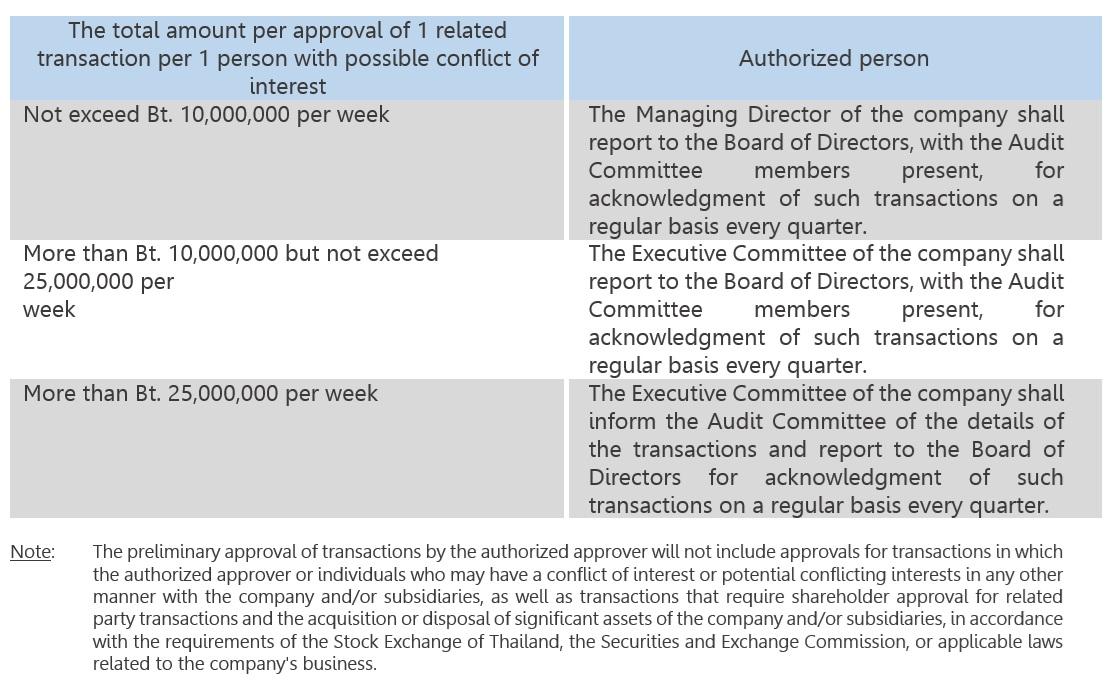
Normal business transactions and other supporting transactions with general business conditions
Selling and purchasing of steel products between the related companies and the Company and the Subsidiary occur continuously. The Company and the Subsidiary will take necessary action when consider that there is a necessity to meet the customers’ demand and benefit can be
As the persons with possible conflict of interest of the Company and/or the Subsidiary are largely involved in the steel industry and the Company and the Subsidiary have high possibility to make the related transaction of the steel product. Therefore, the Company has set stringent measure on delegation of approval authority for such related transactions of the Company and the Subsidiary to ensure transaction transparency and reasonableness and pricing appropriateness, as summarized below.